
Stablecoin Blacklisting and Freeze Functions: Institutional Exposure


On September 29, 2026 the Federal Reserve published its proposed rule implementing GENIUS Act responsibilities for Board-supervised stablecoin issuers at 91 FR 61580, with comments due November 30. Among the requirements is that a permitted issuer hold the technological capability to comply with lawful orders. The April 8 FinCEN and OFAC proposal went further, extending the obligation to secondary-market and peer-to-peer activity. Freeze capability is no longer a vendor choice. It is a licensing condition, and the enforcement point sits somewhere most institutional risk registers have not looked.
Three Primitives, Not One
The USDT contract exposes three distinct operations, and institutions routinely treat them as one.
Freeze, implemented as addBlackList, blocks outbound transfers from an address. Inbound transfers still complete. That asymmetry is the detail that catches people: a payment to a frozen counterparty succeeds, settles, and is then immobile. The sender has not failed to pay. The sender has paid into a locked box.
Destroy burns the frozen balance and reduces supply. The claim is extinguished rather than suspended. In 2025, $1.26 billion was frozen and $698 million destroyed, 55.6 percent of freeze volume, so destruction is the modal outcome.
Unfreeze exists and is rare. Roughly 3.6 percent of 2025 freezes were eventually reversed, with a median wait of 18.2 days. Any control that assumes recoverability is pricing a one-in-twenty-eight event as a base case.
All three are callable only by the issuer's owner multisig, and each emits a public on-chain event. The trust assumption is therefore precise: holding the token means accepting that a named multisig can immobilize or destroy your balance.
The Freeze Is Address-Scoped, the Damage Is Contract-Scoped
As of July 26, 2026 there were 9,597 blacklisted USDT addresses holding $5.69 billion, split $3.71 billion across 6,901 addresses on Tron and $1.98 billion across 2,696 on Ethereum, growing by roughly ten new freezes a day.
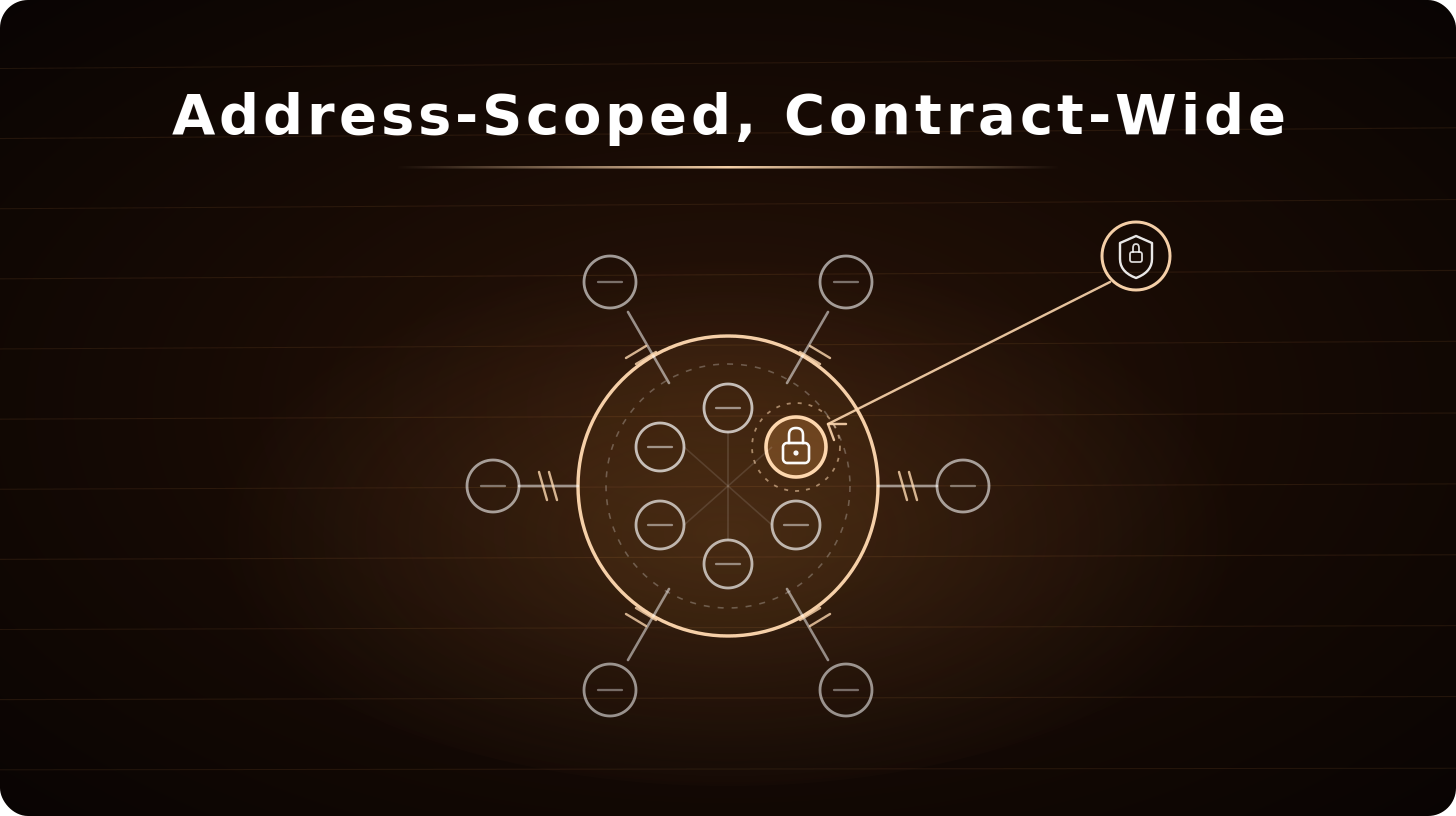
The primitive was designed for an externally owned account. One person, one wallet, one sanction. But the holder of record on-chain is frequently not a person. It is a shared state machine: an AMM pool, a lending market, a vault, an omnibus custody address. Freezing a participant does not isolate that participant. It immobilizes the balance their claim sits inside, and the token contract has no concept of a partially frozen balance held by a contract on behalf of many.
A lending market cannot liquidate a frozen collateral balance, so the position stays open while collateral deteriorates. A pool cannot honor redemptions it still believes it owes. An omnibus address serving many clients becomes one point of failure for all of them, because the contract sees one address.
So the risk register is asking the wrong question. "Will my address be frozen?" is low probability and genuinely controllable through counterparty screening. "Do I share a token balance with an address that will be frozen?" is uncontrollable, almost never monitored, and runs against roughly ten new freezes per day.
The regulatory direction sharpens this rather than softening it. An obligation to prevent blocked persons from engaging with the issuer's smart contracts pushes enforcement toward the token contract boundary, which is exactly where pooled blast radius is widest.
What the Rules Actually Require
Issuers must run risk-based AML and sanctions programs, file suspicious activity reports on primary-market transactions above $5,000, designate a US-based compliance officer, and comply with lawful orders to seize, freeze, burn or prevent transfers. Regulators deliberately declined to prescribe implementation mechanics.
Holders bear no new federal obligations under these specific proposals. That is the asymmetry: the obligation sits with the issuer, and the economic incidence of enforcement sits with whoever shares a balance with the target. Hong Kong's Stablecoins Ordinance has required freeze capability as a licensing matter since August 2025, so this is a converging international standard rather than a US peculiarity.
Defenses That Work and Defenses That Do Not
Counterparty screening before accepting funds is useful and insufficient: it addresses inbound taint and does nothing about pooled exposure, and inbound transfers to a frozen address complete regardless.
Any control built on reacting faster than a freeze should be rejected outright. Published analysis of proposal-to-execution windows between November 2017 and February 2026 found $215.5 million moved out during those gaps, with a median reaction time of 77 minutes. It describes a race an institution will lose, not a control it can rely on.
Four things do work. Diversify across issuers whose keys are held by different entities, because the trust assumption is per-multisig rather than per-asset-class. Hold settlement balances in addresses under sole control, out of pooled positions, accepting the forgone yield as the price. Make contract-level immobilization a diligence question: does this protocol's accounting survive one participant's balance being frozen? Most do not, and almost nobody asks. And allocate the loss contractually in advance, because nearly every custody and trading agreement is silent on who bears a shared-balance freeze.
Residual Risk and What Is Improving
The residual risk cannot be engineered away. Holding a compliant payment stablecoin means holding an instrument whose issuer is required by statute to retain the ability to immobilize or destroy it on lawful order. That is a property of the asset class, not a defect of one issuer, and treating it as a tail risk misreads the design.
What is improving is process rather than exposure. The September 29 Fed proposal and the April FinCEN and OFAC proposal move freeze authority from unilateral discretion toward a supervised framework with documented lawful-order requirements and reporting obligations, while every action remains a public on-chain event. Narrowing discretion into process is the correct direction of travel. For a compliance function the practical step is to stop treating freeze risk as a counterparty screening problem and start treating it as a contract-topology problem, because that is where the loss actually lands.
For informational purposes only. Not an offer to buy or sell any security. Available only to accredited investors who meet regulatory requirements.