
On-Chain FX Displaces CLS for Emerging Market Currency Pairs

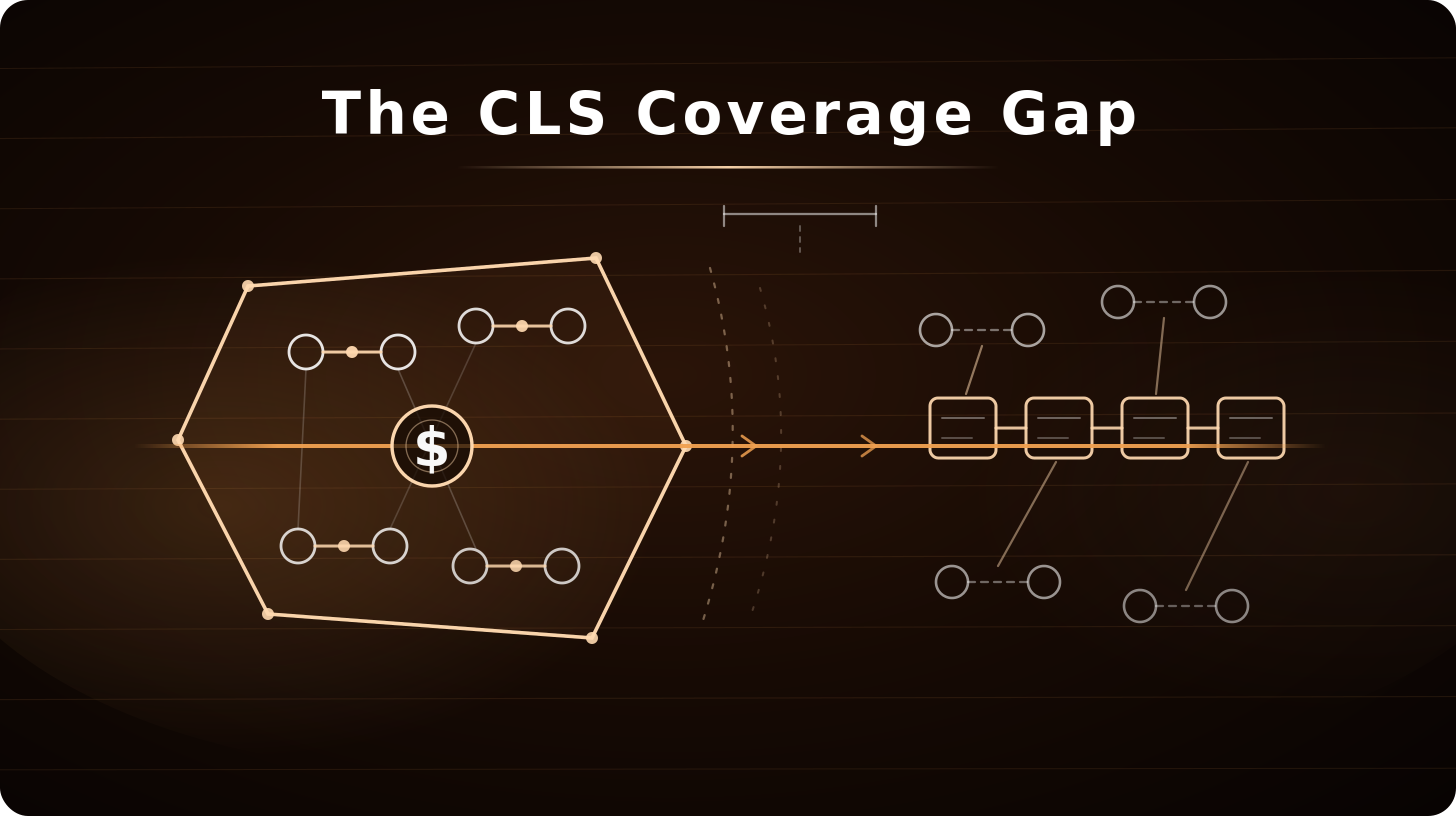

On January 6, 2026, CLS chief executive Marc Bayle de Jesse said the service mitigates roughly 90 percent of settlement risk exposure in its 18 eligible currencies, and that the remaining challenge "lies primarily in those currencies not currently eligible for CLSSettlement," where legal or geopolitical obstacles apply. That is the incumbent naming the hole in its own coverage. Eleven weeks later, BIS Working Paper 1340 found that over 70 percent of fiat-to-stablecoin conversions originate in non-dollar currencies. Something is already moving into that hole. The thesis worth testing is not whether on-chain FX beats CLS, because it does not. It is whether displacement happens in the segment CLS was never able to reach.
What Would Have to Be True
Three conditions. First, the uncovered segment has to be large enough to matter: the 2019 BIS survey put FX trades in non-CLS currencies at about $1.25 trillion, up 35 percent from $930 billion in 2016, and 2025 preliminary BIS estimates leave 10 to 15 percent of turnover still exposed to settlement risk. It is large and growing.
Second, the on-chain leg has to deliver settlement finality a supervisor will accept. Third, it has to do so without needing the same sovereign permission CLS needs. That third condition is the whole thesis, and it is the one almost nobody states.
The Constraint Is Consent, Not Code
CLS cannot simply add currencies. As systemically important infrastructure it must verify that legal, risk and liquidity standards are met in the jurisdiction whose currency is onboarded, and local authorities control the timing. Eighteen currencies is not a technical limit. It is the number of jurisdictions that have agreed.
This is why the displacement argument has any force at all. A tokenized currency can exist without an FMI onboarding process. But that same property is precisely what should make an examiner suspicious, because the permission that CLS waits for is the permission that creates legal finality in the first place.
What a Banking Examiner Would Press On
Two questions here, and a third that needs its own section.
Is it payment versus payment? An atomic swap of two tokens is PvP by construction, and in one narrow respect tighter than CLS, which runs a settlement window and a loss-allocation framework behind it. But PvP on the token is not PvP on the currency. Finality attaches only if the token is a legally final claim on central bank money or a bankruptcy-remote equivalent under the law of that currency's jurisdiction. For most emerging market currencies that wrapper does not exist. The honest description is that Herstatt risk has been exchanged for issuer and legal-finality risk, which is a different risk rather than a smaller one.
Where is the netting? CLSSettlement averaged $8.06 trillion a day through 2025, up from $6.60 trillion in 2023, and it does that by netting multilaterally across 18 currencies so members fund a small fraction of gross. Atomic on-chain settlement is gross by design. Running CLS volumes gross would require prefunded liquidity that does not exist: total stablecoin market capitalization sits near $300 billion against $9.6 trillion in daily FX turnover, meaning the entire float is roughly three percent of one day's trading.
The Dollar Leg Nobody Removed
Ninety-nine percent of stablecoins are dollar-pegged. An on-chain trade between two emerging market currencies is therefore almost never a cross. It is two sequential conversions through a dollar token.
That topology is correspondent banking, reproduced on a ledger with the dollar as the correspondent. The intermediary changed from a money-centre bank to an issuer; the dependence on a dollar leg did not change. CLS at least nets across currencies rather than routing every pair through one. And BIS 1340 attaches a cost to this: a one percent exogenous increase in stablecoin inflows widens parity deviations by about 40 basis points, depreciates the local currency, and expands dollar funding premiums in covered interest parity markets. Emerging market currencies show the largest dislocations and the weakest arbitrage to close them. The parallel market exists, and it prices worse.
CLS's own public policy lead, Dirk Bullmann, calls stablecoins a niche role in wholesale FX and expects hybrid models in which tokenized assets complement rather than replace established settlement networks. That is the better-supported position on current evidence, and worth saying plainly.
Invalidation Conditions
The thesis fails if a legally final non-dollar currency token requires the same central bank sign-off that CLS membership requires. In that case on-chain FX inherits CLS's exact ceiling while offering weaker legal backing and no netting, and displaces nothing. It survives only if finality can come from a lighter regime than full infrastructure onboarding: a local payments or e-money licence with a published finality opinion.
So the variable to monitor is regulatory, not technical, and it reduces to one monthly number: the count of non-dollar currency tokens that are locally regulated and carry a published finality opinion in their home jurisdiction. For major emerging market currencies that count is currently close to zero. Two series are worth tracking beside it: the non-dollar share of stablecoin float, and the on-chain to interbank spread on specific corridors, since BIS modelling suggests halving cross-market frictions would cut exchange rate effects by roughly a third.
The defensible version of this thesis is narrower than its title. CLS does not get displaced. It gets bypassed in a segment it never covered, by rails that are worse on netting and legal finality and better on reachability. That is bifurcation rather than succession, and for a program manager the practical consequence is that any emerging market corridor built on these rails today is carrying a legal-finality exposure that no amount of atomicity resolves.
For informational purposes only. Not an offer to buy or sell any security. Available only to accredited investors who meet regulatory requirements.