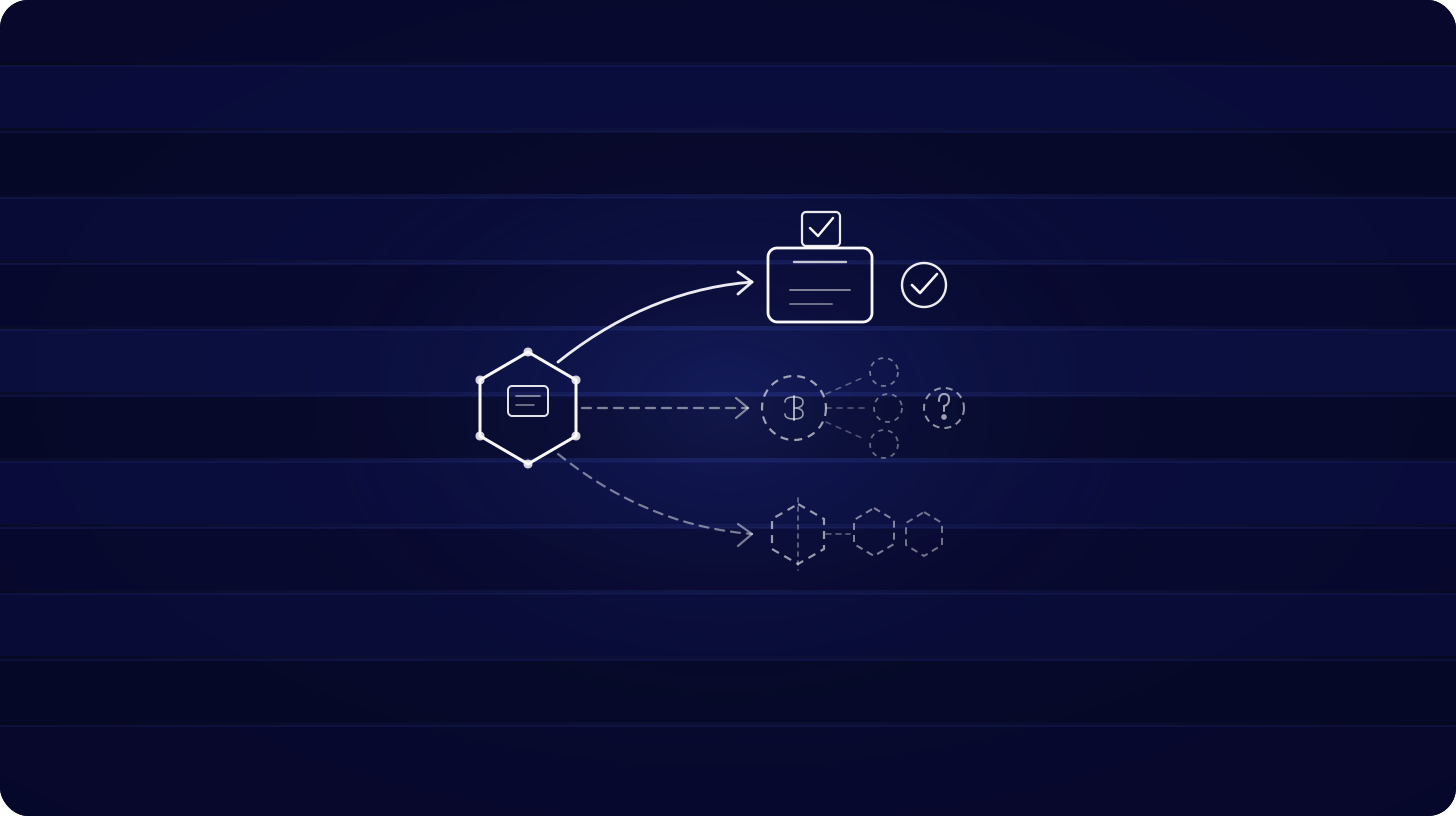
Every Invoice Becomes a Tokenized Receivable



On August 24, 2026, Payment Labs launched a tokenized receivables offering built around a specific lifecycle: authoritative trade data, then a verifiable credential, then a digital identity and wallet, then the tokenized receivable, then financing and settlement. Its chief executive framed the point precisely — tokenization is not about putting an existing invoice on a blockchain, but about building trusted digital infrastructure around the trade asset itself. That distinction is the whole thesis. The Asian Development Bank puts the global trade finance gap at roughly 2.5 trillion dollars, up from 1.7 trillion in 2020, and the shortfall falls hardest on smaller suppliers whose problem is operational friction rather than creditworthiness. Tokenization is offered as the fix. The honest version of the claim is narrower than the title suggests, because most invoices are never financed at all.
The Falsifiable Claim
By December 31, 2030, a material share — call it a fifth — of cross-border financed receivables are tokenized at origination rather than digitized after the fact, and duplicate-financing checks against tokenized registries become standard underwriting practice for receivables lenders. The claim is deliberately not that every invoice gets tokenized. An invoice paid on terms and never pledged gains nothing from a token and carries the cost of issuing one. The economics only work where the receivable is financed, because that is the only point where provenance, uniqueness, and transferability are worth paying for.
What Must Be True and the Constraint Today
Three conditions must convert. First, tokenization must happen at origination inside the ERP or invoicing system, not as a later wrapper, because a token minted after the fact inherits every gap in the record it describes. Second, duplicate-financing detection must work across lenders and borders — the single benefit everyone cites, and one that only functions if participation is broad enough that a fraudster cannot simply route to a non-participating lender. Third, settlement must connect to rails institutions already run, which is why credible offerings integrate with ISO 20022 and instant payments alongside stablecoin settlement rather than replacing them.
The binding constraint is legal, not technical. A receivable is a contractual claim, and transferring it is an assignment governed by the law of the relevant jurisdiction — with rules on perfection, debtor notification, and contractual restrictions on assignment that a token transfer does not automatically satisfy. Moving a token is not the same act as perfecting a security interest, and where the two diverge, the legal position controls. Cross-border receivables compound this, since the assignment may be governed by one jurisdiction's law while the token moves on infrastructure indifferent to all of them.
The Enabling Primitive and a Real Example
The enabling primitive is the verifiable credential chained to the receivable: an attestation from an identified party, cryptographically bound to the trade data, that travels with the token and can be checked by any financier without contacting the issuer. That is what turns an invoice from a document into an asset with provenance, and fractionalization follows from it — a 100,000 dollar invoice split into 100 units of 1,000 — widening the investor base beyond balance sheets large enough to buy whole exposures.
The real example is narrower than the marketing. Duplicate-financing prevention is the one benefit that is genuinely structural: if the same receivable is registered once and pledged once, a second lender searching for matching identifiers finds the prior financing rather than discovering it in a default. That works across borders and banking relationships without a centralized registry, and it addresses a fraud that costs the industry real money. Everything else — faster settlement, secondary liquidity, fractional access — is an improvement on a market that already functions.
What Would Falsify This and the CPA's Question
For a CPA, the audit trail exposes the thesis's weakest joint. A tokenized receivable proves that an invoice was recorded, credentialed, and pledged once. It does not prove that goods shipped, services were rendered, or the amount is genuine. The dominant fraud in receivables finance is not double-pledging a real invoice; it is financing a fabricated or inflated one. Tokenization hardens the uniqueness of a record while leaving the truth of it exactly where it was, and a fabricated invoice tokenized at origination is a fabricated invoice with better provenance metadata. The evidence a financier actually needs — a delivery confirmation, an acknowledged purchase order, a buyer confirmation of the obligation — has to enter the chain from outside it. This is why the credible architectures put authoritative trade data and verifiable credentials before the token, and why any offering that starts with the token is selling the wrong end of the problem.
Three developments would invalidate the thesis: duplicate-financing registries failing to reach cross-lender participation, leaving fraudsters a non-participating route; legal frameworks not clarifying that a token transfer effects a valid, perfected assignment, keeping financiers on parallel paper processes; or tokenized volume concentrating only in captive supply-chain-finance programs where the buyer is already known and the fraud risk was already low, which would prove the technology works exactly where it was least needed. The monthly trackables: financed volume originating as tokens rather than wrapped later, the number of lenders querying a shared duplicate-financing check, credential coverage per financed invoice, and any legal guidance on token-based assignment. The constructive signal is that the sequencing has been learned — the serious platforms now describe a lifecycle beginning with authoritative data and credentials rather than with a chain, which is what separates infrastructure from a wrapper, and the first generation of trade-finance blockchains failed precisely because it got that order backwards.
For informational purposes only. Not an offer to buy or sell any security. Available only to accredited investors who meet regulatory requirements.