
Transaction Monitoring Infrastructure: How KYT Systems Actually Work


A paper published July 9, 2026 (arXiv:2607.07414v2) measured how well the multi-input heuristic actually recovers Bitcoin wallet ownership, and the answer depends on how you score it. Measured pairwise across labeled addresses, precision is 1.00, recall 0.71, F1 0.83. Measured per wallet, against full clusters, precision falls to 0.36, recall to 0.44, F1 to 0.27. Normalized mutual information is 0.41, adjusted to 0.36, and the average error rate is 0.51. One dominant service scored an F1 of 0.825; another mid-sized service scored 0.000. A know-your-transaction system looks and is sold like a ledger query. It is an inference engine, and the inference is where your compliance control lives.
The Four Layers, and Which Ones Are Deterministic
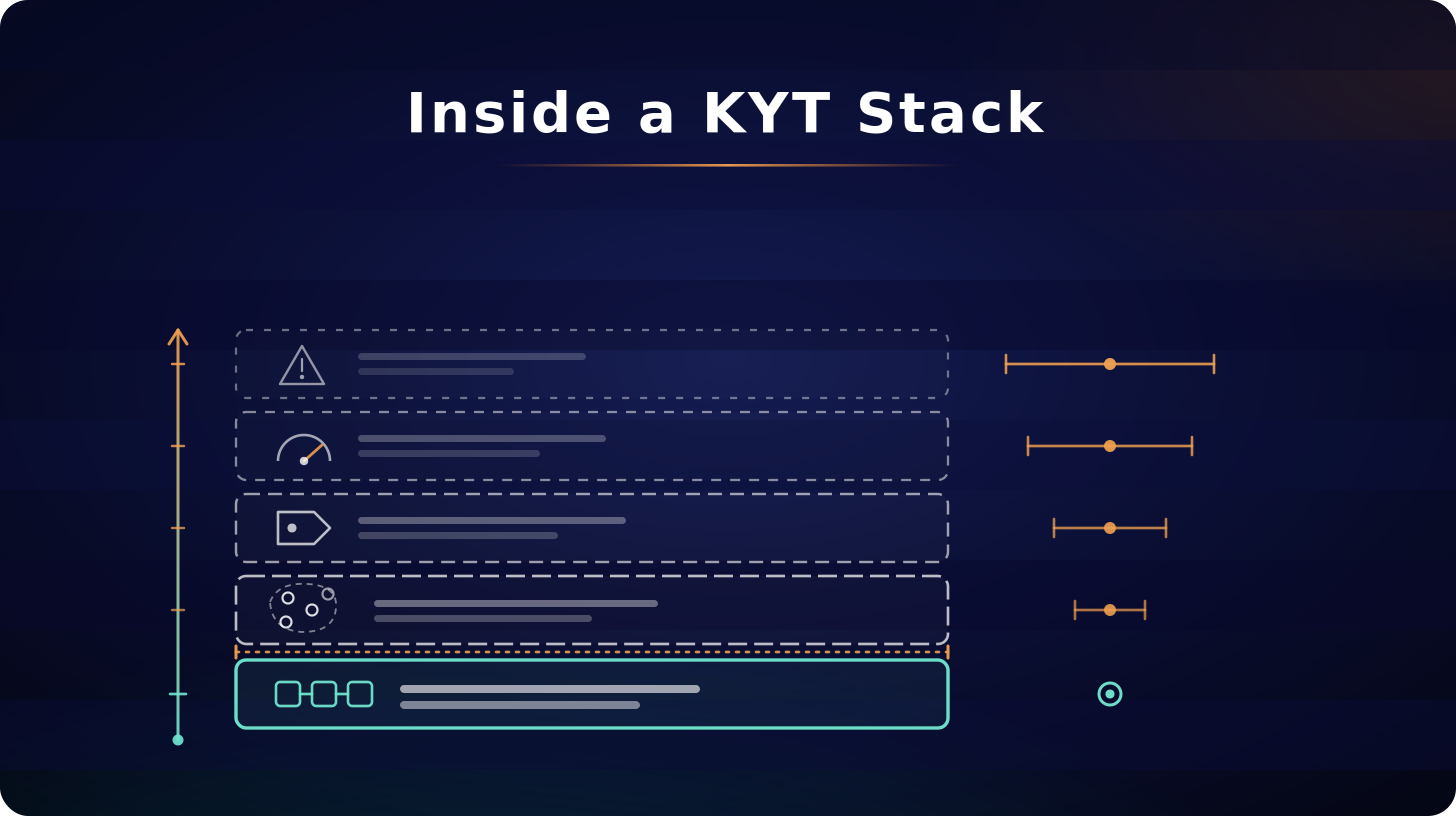
A KYT stack has four layers, and only the first is certain. Ingestion parses raw chain data -- transactions, inputs, outputs, logs, bridge messages -- into a normalized graph. Anyone running a node reproduces it.
Clustering is the first inference. The multi-input heuristic assumes that addresses spent together in one transaction share a controller. Change-address detection and behavioral heuristics extend the cluster further. Nothing here is proven.
Attribution binds a cluster to a named entity -- an exchange, a mixer, a sanctioned wallet -- from scraped deposit addresses, subpoenaed records, and vendor partnerships. This is the proprietary moat and the least auditable layer in the stack.
Risk scoring collapses all of it into a number, usually 0 to 100, then a policy engine turns that number into allow, review, or block. Probability becomes a binary decision and the confidence interval is discarded at the boundary. That discard is the trust assumption a technical program manager is really buying.
Where It Breaks at 2am
Cluster over-merge is the expensive failure: a consolidation or shared-input pattern fuses two unrelated entities, and a clean counterparty inherits another's exposure. Under-merge is quieter and worse: a clean score on a wallet that is not clean. The 0.51 average error rate is not a vendor defect; it is a property of the method.
Entity-level heterogeneity is the operational trap. An average of 0.83 masks a service where recovery is essentially zero, so monitoring works on flows you rarely see and fails on the one venue that matters to your book. Attribution staleness compounds it: an exchange rotates deposit addresses, the label lags, and the graph is briefly wrong in a direction nobody alerts on. Cross-chain and layer-2 coverage remains the thinnest part of every vendor graph, because bridge semantics vary per protocol and UTXO heuristics do not transfer to account-based chains.
Who Pays, Who Earns
The value flow explains the data moat. Elliptic raised $120 million on May 12, 2026 at a $610 million valuation, led by One Peak with Nasdaq Ventures, Deutsche Bank, and the British Business Bank participating. The firm says exchanges using its services carry two-thirds of global crypto trading volume, against roughly $33 trillion in stablecoin transactions last year. Institutions pay by seat and by screening volume; vendors earn by owning attribution nobody else can rebuild.
Buying versus building is therefore not a software decision. Ingestion and clustering are reproducible in-house; attribution is not, because it rests on commercial relationships and investigative work. Any build plan assuming otherwise underestimates the project by years.
What the Automation Layer Actually Changes
Chainalysis announced Blockchain Intelligence Agents at its Links conference on March 31, 2026, with rollout beginning summer 2026: agents that enrich alerts with context and run multi-chain investigations with complete audit trails, drawing on billions of screened transactions and more than ten million prior investigations. Elliptic reports its own copilot cutting processing time by as much as 50 percent. Chainalysis grounds outputs in verified chain data rather than a general-purpose model, the right instinct: in a regulated workflow an unreproducible answer is worse than a slow one.
But automation compresses triage; it does not repair attribution. Running an agent over a graph with a 0.51 error rate produces wrong conclusions faster and with better prose. The control that matters is an audit trail running from the decision back to the specific heuristic and label that drove it, so an examiner sees not just what was blocked but why the system believed it.
What to Watch
Three things. First, whether vendors expose per-entity confidence at the API rather than one composite score, which would let institutions tier controls instead of treating a 0.36 precision cluster and a hard sanctions match identically. Second, cross-chain and layer-2 attribution coverage, stated as a percentage of your own flow rather than as a chain count. Third, alert disposition rates measured over time, which tell you whether tuning is working or whether analysts have quietly learned to clear a noisy rule.
The honest version of the pitch is narrower than the marketing. These systems are the best available instrumentation for on-chain flow, and this year's automation layer is a real gain in analyst throughput. They are also probabilistic systems whose error is concentrated exactly where dataset averages hide it. Build the policy engine to respect that, and the stack is an asset. Treat the score as ground truth, and you have automated a heuristic into a control.
For informational purposes only. Not an offer to buy or sell any security. Available only to accredited investors who meet regulatory requirements.