
Active Loans and Utilization: Reading Lending Market Health


Outstanding loans on Base hit a record $2.75 billion on September 10, 2026, per Artemis. Across DeFi, active loans reached $26.1 billion in late August, up 30 percent from $20.1 billion in June, after months of contraction. Aave holds roughly $12.5 billion of that, about 48 percent, with deposits past $30 billion. Morpho crossed $5 billion in outstanding loans on September 1, a record. Those are supply and demand stocks, and the number that carries information is the ratio between them. It has an awkward property: the reading that says a lending market is healthy and the reading that says it is fragile are the same reading.
What Utilization Measures
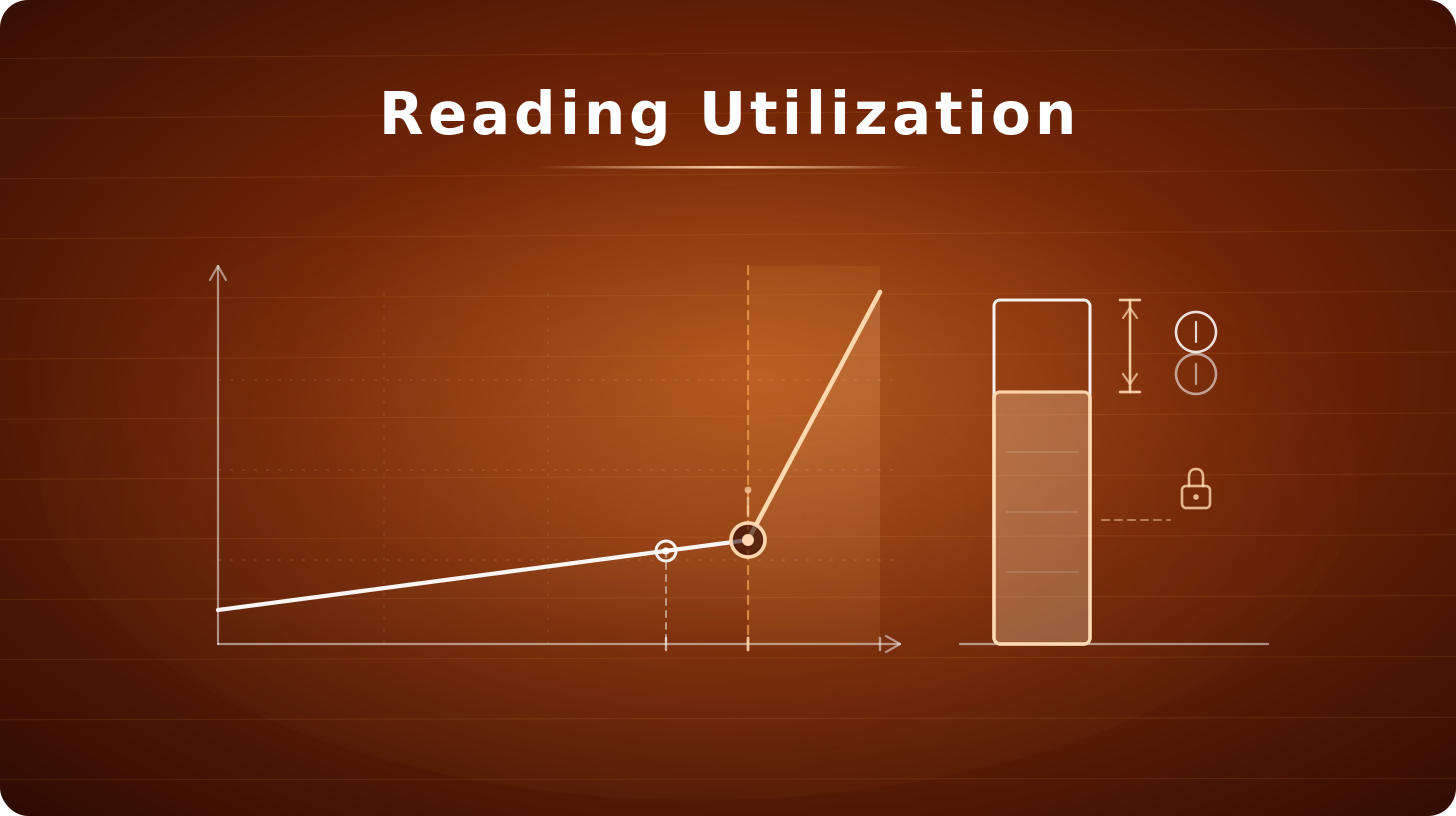
Utilization is outstanding borrows divided by total supplied, per asset per market. In a floating-rate pool it also drives the interest-rate model. Rates rise gently to a kink, typically between 80 and 90 percent, then steeply above it. That curve is the only mechanism forcing repayment; nothing else obliges a borrower to return capital on any schedule.
TVL tells you how much capital arrived. Utilization tells you whether anyone wanted it. A pool holding a billion dollars at 15 percent utilization is not a lending market; it is a parking lot earning a subsidy.
Run the reported figures. Aave shows roughly $12.7 billion in loans against $17.7 billion TVL. Morpho shows $5 billion against $9.55 billion. That is about 72 percent against about 52 percent. The same gap appears on Base, where Morpho carries $1.93 billion in loans against $3.94 billion TVL while Aave V3 carries $354 million against $513 million. Two protocols growing in the same direction, on the same chains, running twenty points apart on capital efficiency.
Where the Denominator Lies
Before trusting that gap, check what the denominator counted.
First, TVL definitions differ on whether borrowed funds remain in the total. Gross and net supplied produce materially different utilization for the same pool, and dashboards do not always say which they report. Recompute from raw supply and borrow balances rather than dividing a headline by a headline.
Second, looping. A borrower who supplies collateral, borrows against it, and redeposits the proceeds inflates both numerator and denominator. Utilization looks stable while genuine outside demand has not moved. Recursive positions are traceable on-chain, and they are the single largest source of flattering lending statistics.
Third, incentives. Supply chasing a token emission depresses utilization by padding the denominator with capital that leaves when the program ends. Fourth, aggregation. Netting across assets or chains averages an over-subscribed stablecoin pool against a dormant long-tail pool and hides both.
Other Numbers That Matter
Three readings improve the signal. The borrow rate relative to the kink shows where on the curve a pool sits and how much room remains before rates go vertical. Interest actually accrued confirms the loans are live rather than parked: Morpho markets generated over $4 million in one August week, the highest since November 2025.
Composition matters more than it is usually weighted. Morpho's book is 95 percent stablecoins and 62 percent USDC. That is a concentrated, well-understood liability, and a single depeg or issuer action propagates straight through the book.
Collateral and distribution concentration is the third. Coinbase's integration has produced roughly $1.3 billion in USDC borrowing against about $2.5 billion in cbBTC, at rates near 5 percent with an 86 percent liquidation threshold and a $5 million ceiling against bitcoin. Galaxy research puts Aave and Morpho together at 53.1 percent of all DeFi lending TVL. Concentrated distribution is efficient and correlated at the same time.
Healthy Versus Fragile Are the Same Number
Over twelve months, a healthy market shows utilization climbing into the sixties and seventies with borrow rates below the kink, interest accrual rising with balances, collateral diversifying, and supply persisting after incentives end.
Now read the same trend the other way. Utilization above the kink means lenders cannot all withdraw, because the capital is lent out. The exit is exactly as crowded as the market is efficient. A pool at 95 percent is producing the best yield in the category and offers almost no redemption capacity to anyone who wants out first. Aave's April KelpDAO exploit erased over $10 billion in TVL before the protocol recovered, a reminder that the denominator moves fast for reasons unrelated to borrowing.
Both readings are correct. An allocator optimizing for the highest-utilization pool buys the highest yield and the thinnest liquidity in one decision, and should size it as a liquidity position, not a yield position.
What a 10x Actually Requires
Instant redemption and high utilization are in direct tension, and no amount of growth in a floating-rate perpetual pool resolves it. Pushing utilization toward 100 percent to scale the loan book makes redemption worse in proportion. The ceiling is not about attracting capital.
Ten times the current book therefore requires growth from somewhere else: fixed-term, fixed-rate credit where the lender has agreed not to redeem on demand, so utilization can run high without an implied liquidity promise behind it. It is what institutional credit already does, and what would let a $26 billion market become a $260 billion one without making every pool a queue.
The constructive signal is that the architecture is already drifting that way. Isolated markets with curator-set caps, which is most of what explains Morpho's lower utilization, are not inefficiency. They are the first version of term and risk segmentation showing up in a floating-rate world. Watch utilization per market against the kink, not protocol totals, and watch whether term products take share. That is the number that would tell you the ceiling is moving.
For informational purposes only. Not an offer to buy or sell any security. Available only to accredited investors who meet regulatory requirements.